
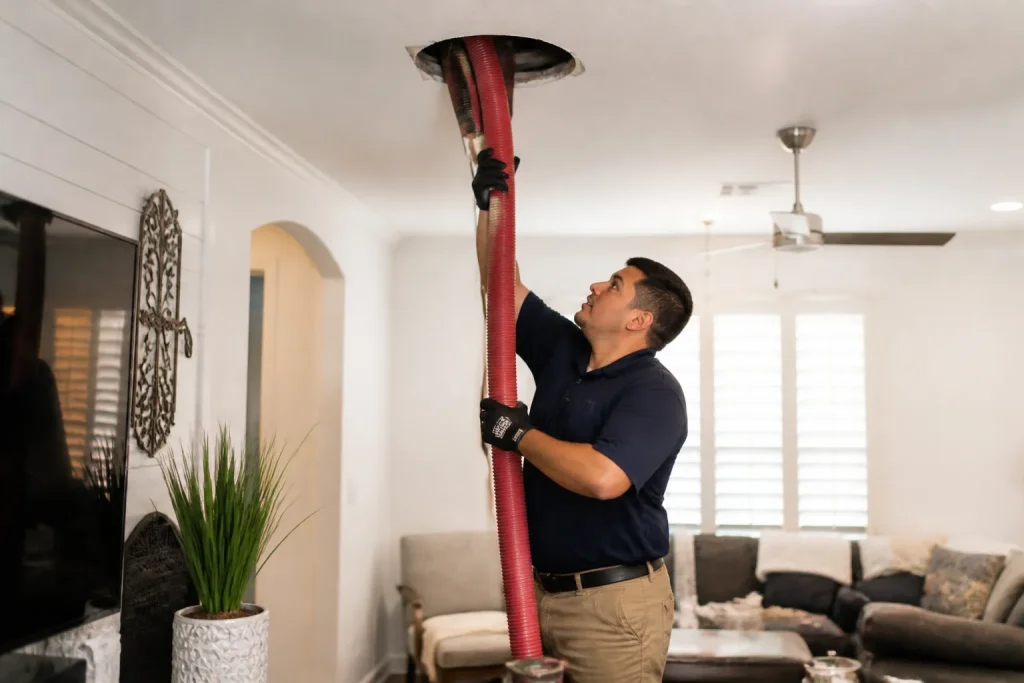
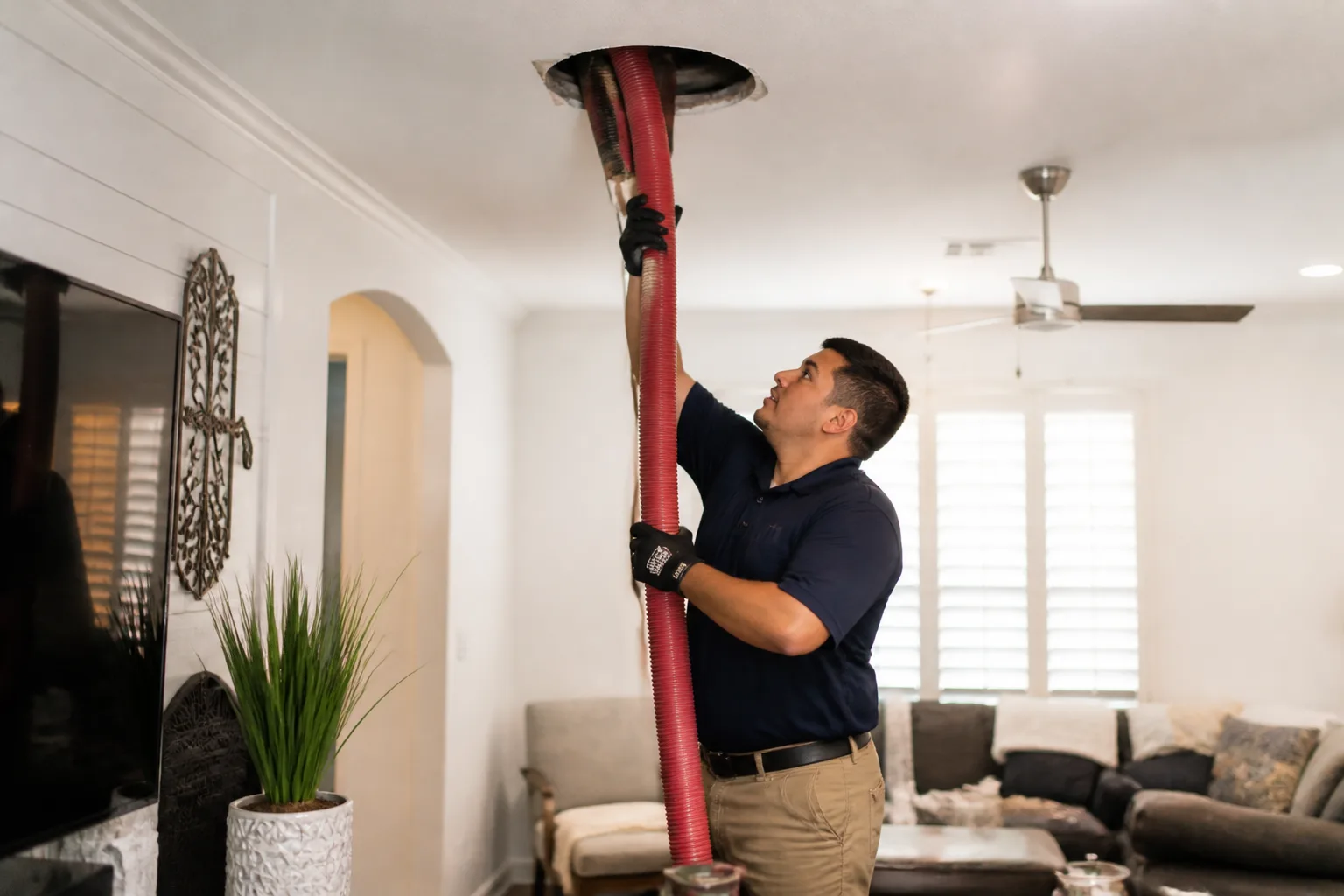
How to Choose the Right Air Duct Cleaning Company in McAllen
Most homeowners in McAllen pick a duct cleaning company the same way they pick a pizza place: whoever shows up first with the lowest number. That’s understandable, and it’s also how people end up paying for a machine that never touched the inside of their duct walls. The right question isn’t about price or reviews. It’s about equipment. Ask what vacuum system the company runs and how they verify negative pressure during the job, and the rest of the answer usually sorts itself out. If you’d rather skip the research, call (888) 971-5813 and we’ll walk you through what a real cleaning involves.
What should I ask a duct cleaning company before booking?
Ask five specific questions before anyone puts a deposit down or schedules a visit. The answers tell you more than any website copy.
- What’s your vacuum’s CFM rating, and is it truck-mounted or portable? CFM (cubic feet per minute) measures how much air the vacuum moves. A portable shop-style unit typically pulls a fraction of what a truck-mounted or high-capacity industrial unit does. Ask for the number, not a description.
- How do you verify negative pressure during the job? Negative pressure means the vacuum is pulling air toward the machine rather than pushing dust into your living space. A company that can explain their method is a company that has thought about containment.
- Are you cleaning the return system, or just the supply side? Return ducts carry the dirtiest air back to the unit. If a quote only covers supply vents, you’re getting half the job.
- Do you inspect before quoting? A phone quote without a look at your system is a guess. It’s a reasonable guess for a standard layout, but it’s still a guess.
- What equipment do you bring besides the vacuum? Contact cleaning tools agitate the dust stuck to duct walls so the vacuum can actually remove it. Vacuum alone leaves a film behind.
In our experience, the answers to those five questions separate a company that cleans ducts from a company that waves a hose around. Our technicians have up to 12 years of experience, and the ones who last in this trade are the ones who can answer all five without pausing.
How do I read a company’s equipment language without getting fooled?
Equipment language in this industry is engineered to sound impressive and say almost nothing. “High-powered vacuum” and “HEPA filtration” get used on everything from a true industrial setup to a shop vac with a marketing budget. Here’s how to translate.
- “High-powered vacuum” means nothing on its own. Ask for CFM and the make and model. A company running Rotobrush contact cleaning alongside a Nikro industrial vacuum will tell you so by name, because the equipment is the pitch. Anyone who won’t name the machine is usually hoping you don’t ask.
- “HEPA filtration” refers to a filter standard, not a cleaning method. It matters when it’s part of a containment process that keeps dust out of the living space during the job. Ask where the filtration sits in the workflow, not just whether it exists.
- “Truck-mounted” is generally a shorthand for higher capacity, but the number that matters is still CFM and how the machine is set up for your home’s layout. Some McAllen houses have long runs that challenge a portable unit.
- “Containment” is the word to listen for. A company that runs Abatement Technologies filtration during service is treating your home like a remediation site, which is the right instinct for a job that involves disturbing settled dust.
If a company’s website describes its equipment in adjectives rather than model names, that’s your answer. Drag the “high-powered” language through the mud and see what’s left.
What does NADCA certification actually guarantee?
NADCA certification is a legitimate credential, and it’s worth knowing what it does and doesn’t cover. NADCA (the National Air Duct Cleaners Association) sets standards for technician training and cleaning practice. A certified technician has been tested on how systems should be cleaned, what access points are needed, and how to handle different duct materials.
What it doesn’t guarantee is equipment minimums. Certification covers training, not hardware. A certified technician can still show up with an undersized vacuum, because certification doesn’t dictate the CFM of the machine in the van. That gap is where a lot of disappointing jobs happen. You get a properly trained person running inadequate equipment, and the training can’t compensate for a vacuum that can’t lift what’s stuck to the duct walls.
So treat certification as a floor, not a ceiling. Ask about it, absolutely. Then ask the equipment questions above. A company that’s certified and willing to name its machines is in good shape. A company that’s certified and vague about hardware is halfway there.
What red flags should I watch for in the McAllen market?
Some patterns show up again and again with duct cleaning complaints in McAllen, and they’re usually visible before you book. Here’s what to watch for.
- Per-vent pricing that sounds too good. A very low number per vent is a door-opener. It often gets you a crew with a portable unit and a short visit, or a base price that grows once they’re in the house. Whole-system pricing, agreed before work starts, is the cleaner arrangement for everyone.
- No inspection before quoting. Legitimate companies want to see your system, or at minimum ask detailed questions about its layout and age. A quote given without either is a number pulled out of the air.
- Mid-job upsells. If a technician suddenly recommends a service you didn’t discuss, ask them to stop and put it in writing. A service that wasn’t in the written estimate shouldn’t appear on the invoice.
- No before-and-after photos. Photos of your own ducts, taken at the access points, are the simplest proof a job happened. A company that won’t take them is a company that doesn’t want you checking.
- Vague answers about return systems. If a company can’t explain whether they’re cleaning returns, they probably aren’t.
None of this is about being suspicious of everyone. It’s about asking the questions a good company welcomes. The ones who answer without flinching are the ones worth your time.
How do I verify the job was done correctly?
You don’t need special equipment to check most of it. Do these three things right after the technician finishes, while they’re still there to answer questions.
- Inspect the access points. Look at where they cut into the ductwork to reach the interior. The covers should be sealed properly, not taped over loosely or left with gaps. Sealed access points matter because a leak there pulls unfiltered air into the system.
- Check the filter. Your furnace or air handler filter should look the way it should after a clean job: replaced or refreshed, not coated in a fresh layer of dust from the cleaning itself. A dust-caked filter right after a cleaning tells you containment didn’t hold.
- Compare airflow. Note how the airflow feels at a few registers before the cleaning, then check again after. It should be the same or better, not weaker. Weaker airflow can mean a damper got closed or a duct got disturbed.
Ask for the before-and-after photos too. A company running Abatement Technologies containment and Rotobrush contact tools will typically have photos as part of the job record, because the visual proof is the point. If a company shrugs at the request, that tells you something about how they think about accountability.
When to call a pro
If you’ve done the checks above and something still feels wrong, or if you’ve noticed persistent dust, musty odors, or allergy symptoms that won’t let up, it’s worth having the system looked at properly. Our technicians have up to 12 years of experience and can inspect the return side and the supply side in one visit. We answer 24/7 and offer fast dispatch from 7am to 7pm, Sunday through Friday, with Saturday closed.
Related services in McAllen
We handle more than air duct cleaning in the McAllen area. Dryer vents are another job worth booking alongside duct cleaning, since dryer vent cleaning addresses a leading cause of residential fires rather than just airflow. If ducts turn out to be damaged or leaking, air duct repair is available so the system is fixed at the source instead of cleaned and left to degrade again.
The Bottom Line
Choosing a duct cleaning company comes down to equipment and transparency. Ask about CFM, negative pressure verification, return system coverage, and pre-quote inspection. Name your tools: a company running Rotobrush contact cleaning and Nikro extraction with Abatement Technologies containment is telling you exactly what it brings to the job. NADCA certification is a floor, not a finish line, and photos plus a written estimate set the price before anything starts. If you’re in McAllen and need help, Duct Cleaning McAllen offers free estimates. Call (888) 971-5813.
Frequently Asked Questions
Most whole-system cleanings in McAllen land in a few hundred dollars, with the exact figure depending on system size, number of vents, and whether returns are included. Pricing is per job by written estimate, not per vent. Call (888) 971-5813 for an exact quote, which is free.
Cheaper quotes usually reflect a smaller vacuum, less time on site, or a per-vent base price that grows once the crew arrives. A portable unit pulling a fraction of the CFM takes less time and costs the company less to run. Ask for CFM and equipment names, and the price gap usually explains itself. Call (888) 971-5813 to compare a quote that names its equipment.
Ask for before-and-after photos taken at your access points, check that the access covers are properly sealed, look at your filter condition, and compare airflow at the registers. A company proud of its process will hand you the photos without being asked. Call (888) 971-5813 to schedule an estimate.
For most McAllen homes, every three to five years is a reasonable rhythm, with more frequent cleaning if you’ve had recent remodeling, pets, or persistent dust and allergy symptoms. It’s not a set-it-and-forget-it job. Call (888) 971-5813 and we’ll give you an honest read on your system.
Cleaning removes settled dust and debris from the duct walls, which reduces the material available to get stirred back into the air. It’s not a medical treatment, and it works best when the ducts are clean and the system is properly sealed. If your ducts are leaking, air duct repair is part of the fix.
At minimum, a machine with a real CFM rating, contact cleaning tools that agitate dust off the duct walls, and some form of containment so the cleaning doesn’t spread dust through the house. Our technicians use Rotobrush contact cleaning and Nikro extraction with Abatement Technologies filtration during service, and we work with Honeywell and Aprilaire whole-home air quality systems when the job calls for it. Call (888) 971-5813 to talk through your system.
Written by the team at Duct Cleaning McAllen.
Need Air Duct Cleaning Help?
Call Duct Cleaning McAllen - licensed & insured, here with fast help in McAllen.
(888) 971-5813