
Emergency Air Duct Cleaning Near Me: What McAllen Homeowners Should Do First
If raw sewage, floodwater, or a dead animal has contaminated your duct system, running your HVAC while you search for a cleaner is actively distributing the problem through every room in the house. Turn the system off first. That single step buys you time and keeps the contamination from spreading while you figure out what you’re dealing with. Most “duct emergencies” aren’t solved by a fast phone call; they’re solved by the right first move. And if you’d rather have a technician walk you through it, call (888) 971-5813.
What Should You Do First Before Calling Anyone in McAllen?
Shut the system down at the thermostat before you open a browser or pick up the phone. In our experience, the callers who get the cleanest resolution are the ones who stopped the air handler within the first hour. A running system pulls contaminated air through the return, pushes it past the evaporator coil, and delivers it to every register in the house. What started in one room becomes a whole-home problem.
Here’s the order that works in McAllen:
- Turn off the HVAC at the thermostat. Not just to “fan only” – off.
- Note the time and what happened. Floodwater, pest, or odor. Each has a different starting point.
- Photograph the damage before touching anything. Registers, visible debris, water lines on drywall.
- Keep occupied rooms closed off so foot traffic doesn’t grind contamination into carpet or push it back into the return.
- Call and describe the event, not just the symptom. “Sewage backed up Tuesday” tells us more than “my ducts smell.”
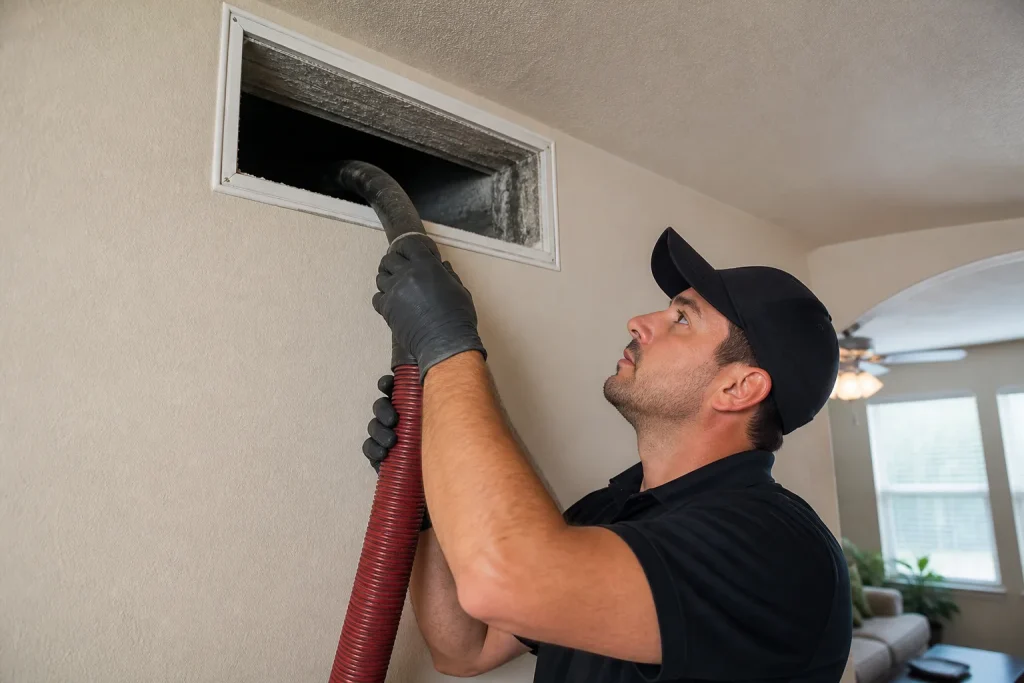
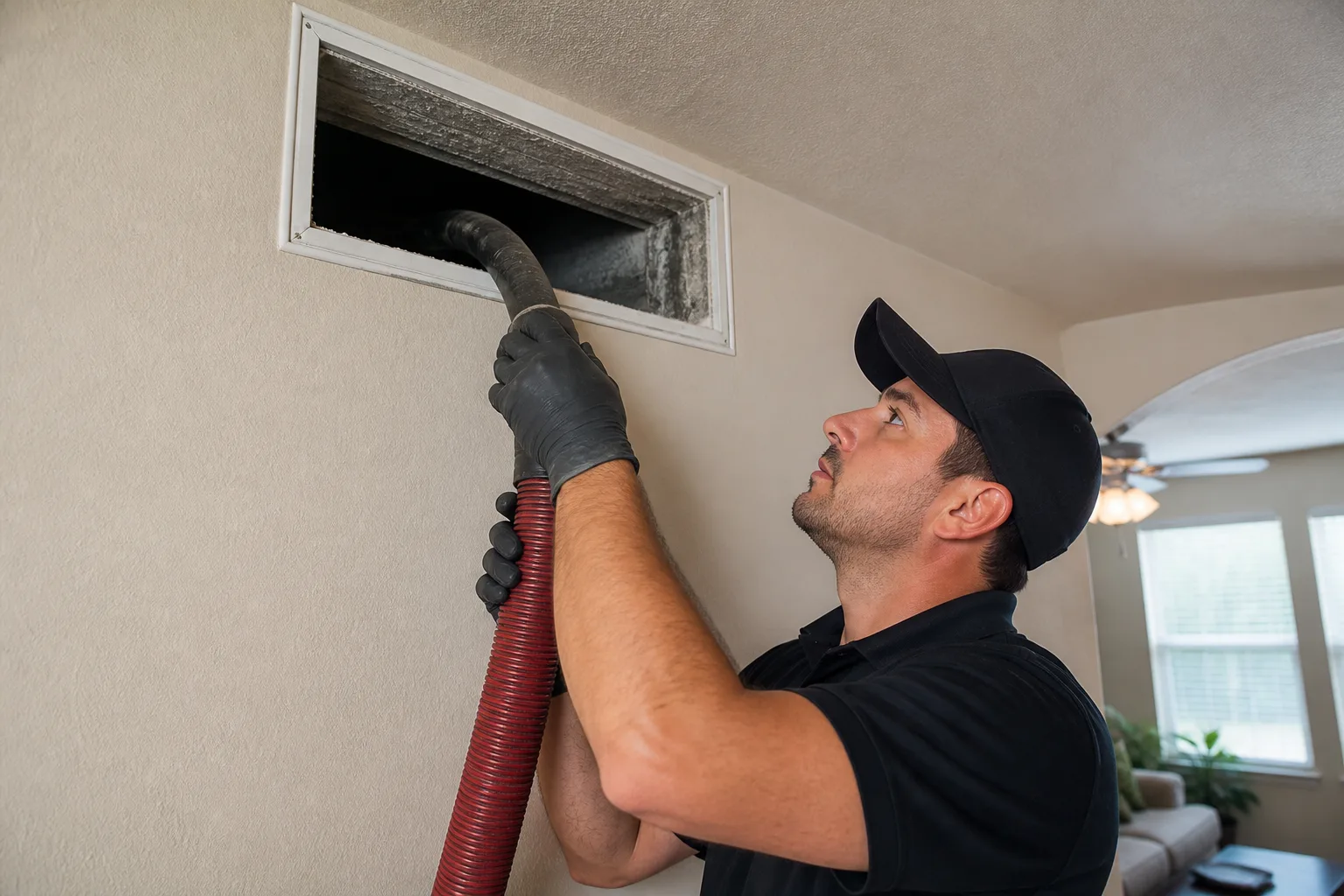
One thing you don’t want to do is fire up a shop vac and start pulling debris out of a register. That can spread fine particles into the air rather than capturing them, and it moves the problem sideways instead of out. Industrial extraction with containment-grade filtration, like the Abatement Technologies setup we run during every service, is built for exactly this.
Post-Flood Contamination: What Changes in McAllen’s Climate?
After any flood event in McAllen, the priority is moisture, not dust. Standing water and soaked insulation inside ductwork create a warm, humid environment that supports microbial growth within days. McAllen’s heat doesn’t help: a system that’s off but sitting wet in a 95-degree attic is a petri dish. Turn it off, get the water out of the ducts, and don’t restore airflow until the inside surfaces have been cleaned and dried.
What we’ve learned working this climate: the damage isn’t always visible at the register. Water wicks along fiberglass liner and pools in low runs of flexible duct. That means a visual inspection from the vent covers tells you almost nothing about whether the system is affected.
Before calling, do these three things:
- Photograph the high-water mark on walls or floors near air returns.
- Write down what kind of water it was. Clean rainwater, greywater from a sink, or sewage are three different jobs with three different urgency levels.
- Tell the technician whether the HVAC was running during the flood.
Sewage and greywater events move to the front of the line. Rainwater that never reached the ducts may only need a register-and-grille cleaning once things dry out.
Pest Infiltration: Why the First Step Is Different
Animal or insect contamination needs a different first move: find the entry point and block it. Without that, cleaning the ducts is just setting the table again. Rodents and insects use the same gaps in ductwork that waste your conditioned air, which is why pest infiltration and duct leaks tend to show up together.
What you can do immediately:
- Shut off the system so droppings and debris aren’t blown through the house.
- Photograph what you can see at registers and grilles without reaching in. Droppings, nesting material, and dead insects all matter.
- Look for the gap or break where the animal got in. Common spots are unsealed boots, disconnected flex runs in the attic, and rotted return chases.
- Don’t run a standard vacuum to clean it up. Rodent droppings carry hazards that need HEPA-grade capture, not a household bag.
This is where air duct cleaning and repair belong in the same conversation. Sealing a breach is part of solving the problem, not a separate line item. In our experience, an infestation that gets cleaned but not sealed is back within a season.
Sudden Mold Odor: When It’s a Duct Emergency
A musty smell that appears over weeks is usually a maintenance issue. A mold odor that shows up overnight, or right after a water event, is a different situation. Shut the HVAC off, keep the house ventilated with open windows if the outdoor air is dry, and get someone to look at the inside of the ductwork before you run the system again.
The tricky part is that a musty smell isn’t proof of mold inside your ducts. It could be a wet coil, a clogged condensate drain, or a damp return plenum. That’s why we inspect the full path, not just the ducts in isolation. Honeywell and Aprilaire whole-home systems can be part of the answer once the source is found, but they can’t fix a moisture problem that’s still active.
If a technician or HVAC contractor pushes back and wants to re-run the system before the ducts are inspected, hold your ground. Explaining it this way usually works: “I’m concerned about spreading contamination through the house. I’d rather leave the system off until the inside of the ducts is checked.” A professional will respect that. Your ducts work harder than you think when the system is pushing through a wet filter and coil, and every cycle spreads whatever is growing inside.
Registers and Grilles, or the Whole System?
This is the question that determines both urgency and cost, and most homeowners can answer it themselves with a careful look. Registers and grilles are the visible covers. The ducts are the hidden runs inside the walls, floors, and attic. If the trouble is only at the surface, it may be a simple cleaning. If the trouble is inside the ductwork, it’s a whole-system job.
A quick way to tell:
- Surface-level only: dust and debris on the register face, no visible damage to the ducts, no odor when the system runs.
- Systemic: odor travels to multiple rooms when the system runs, visible debris appears at several registers at once, or you can see inside the ducts and they’re coated.
For a systemic issue in McAllen, the right equipment matters. Rotobrush contact cleaning physically agitates the duct walls while Nikro industrial extraction pulls the loosened material out under high vacuum. A blower alone won’t get there.
What Documentation Should You Collect Before Cleaning Begins?
Collect photos, timestamps, and a written description of the source event before any cleaning work starts. That bundle is what your insurer will ask for. Cleaning before documenting can cost you a claim, because the visible evidence is gone.
What to gather:
- Photos of every affected register and grille, with something for scale in the frame.
- The date and time of the source event (flood, pest discovery, odor onset).
- Photos of any water mark, damaged drywall, or animal entry point.
- A short paragraph in your own words describing what happened and when.
- Any contractor report or HVAC invoice tied to the event.
In our experience, insurance adjusters respond better to a clean package than to a phone call explaining the situation. We can work with your insurer and provide service records, but the documentation is yours to protect.
True Emergency or Manageable Problem?
A true emergency means shutting the HVAC off now and getting service on the day you call: sewage contamination, active flooding into the ductwork, a live pest breach, or an odor that makes the house unsafe to occupy. Those need same-day response and a system that stays off until it’s addressed.
Manageable situations look different. A musty smell that’s been building for a month. Dust on the registers but no odor. A single small animal that’s already gone. In those cases, shut the system off, close off the affected room, and schedule a full appointment without rushing.
One thing we don’t do is promise the moon on a Saturday. We’re closed on Saturdays. If your system fails on a weekend, turn it off, document what you see, and call. We answer 24/7, and a call outside dispatch hours gets booked into the next opening, Sunday through Friday, 7am to 7pm.
When to Call a Pro
Call a professional duct service when the contamination is inside the ductwork rather than on the register faces, when the source event involved water or sewage, or when the smell doesn’t clear after the filter and coil have been checked. Those are the situations where shop-vacs and DIY cleaning make things worse, not better. Our technicians have up to 12 years of experience, and we use industrial equipment on residential jobs because that’s the only way to solve a systemic problem. Call (888) 971-5813 for a free estimate. We answer 24/7. Fast dispatch from 7am to 7pm, Sunday through Friday.
Related services in McAllen: dryer vent cleaning, which is a fire-safety service worth scheduling alongside a duct cleaning, and air duct repair for breached or leaking ductwork. If you want the full picture of what we offer, start at Duct Cleaning McAllen.
The Bottom Line
Shut the HVAC off first. Document the source event. Then call, and describe the event rather than the symptom. Post-flood, pest, and mold-odor situations each need a different first move, and each resolves better when the system stays off until a technician confirms the ducts are clear. Our clean, repair, protect sequence is designed to keep a solved problem from coming back.
If you’re in McAllen and need help, Duct Cleaning McAllen offers free estimates – call (888) 971-5813. The price is set per job by the written estimate, and our technicians use Rotobrush contact cleaning and Nikro extraction during every service. We answer 24/7. Fast dispatch from 7am to 7pm, Sunday through Friday.
Frequently Asked Questions
No. Turn it off at the thermostat. Running the system during an active contamination event pushes contaminated air through the return, past the evaporator coil, and out to every register in the house. Keeping the system off until a technician confirms the ducts are clear is the single most important first step.
It depends on timing. A musty smell that builds over weeks is usually a maintenance issue like a wet coil or clogged drain. A mold odor that appears overnight, or right after a water event, should be treated as urgent: shut the HVAC off and get the ducts inspected before running the system again. If you’re not sure which you have, call (888) 971-5813 for guidance.
Every affected register and grille, any water mark or damaged drywall, the animal entry point if there is one, and a written description with timestamps of the source event. Photograph before any cleaning work starts. Cleaning first can cost you an insurance claim because the visible evidence disappears.
Register cleaning addresses the visible covers. Whole-system cleaning addresses the inside of the ducts. If the odor travels to multiple rooms when the system runs, or visible debris shows up at several registers at once, you’re looking at a systemic issue that needs industrial extraction rather than a surface wipe-down. Call (888) 971-5813 for an honest assessment of which you have.
Written by the team at Duct Cleaning McAllen.
Need Air Duct Cleaning Help?
Call Duct Cleaning McAllen - licensed & insured, here with fast help in McAllen.
(888) 971-5813